Saturday 25th June
I was taking it easy (even more so than usual) during the day, because
I planned to go into Castiglione del Lago in the evening for their
"Notte Bianca": literally "white night", but generally in Italian it
means a sleepless night. However, in a festival, it's an overnight
programme of revelry, in this case with events scheduled from 9pm to
6am. I doubted very much if I woould still be around at six, and in
fact, really had no idea what to expect, but it seemed intriguing.
I drove over to Castiglione after nine. I guessed that there would be
no hope of finding a parking space near the old town, but the car parks
around the lake shore should have ample capacity, and this proved to be
correct. It was a ten minute walk uphill to the city gate. Actually,
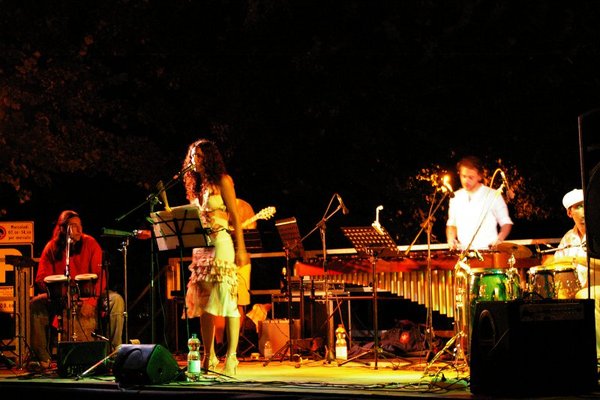
the events were occurring in both places. In the streets and piazzas of
the old town were live concerts, a samba troupe, stiltwalkers and
fireaters, and the usual mix of town festival entertainment. Down by
the shore, it was thumping dance music "for the kids".
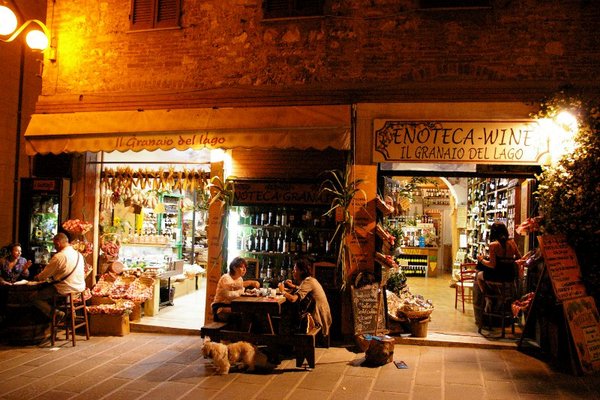
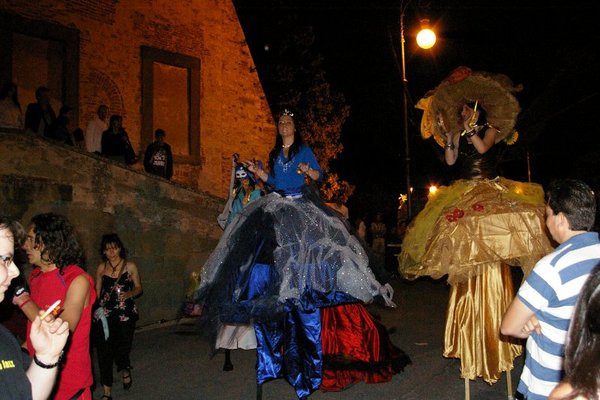
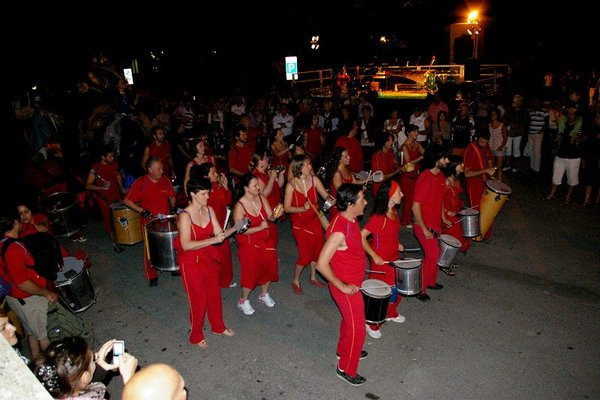
The streets were already fairly packed, although none of the acts had
actually started yet. The biggest stage was in the castle yard. which
incorporates a kind of amphitheatre, where they show films in the
Summer. This was for the big stars, the hosts of a television variety
show, "Zelig". Having seen the programme and being fairly sure it
wasn't my kind of thing, I didn't wait for the show to start.
But the samba band was starting up, and they led a parade though town.
There was a Brazilian/Latin band opposite Palazzo della Corgna (the
singer spoke only Portuguese - I had no idea what she was saying) and a
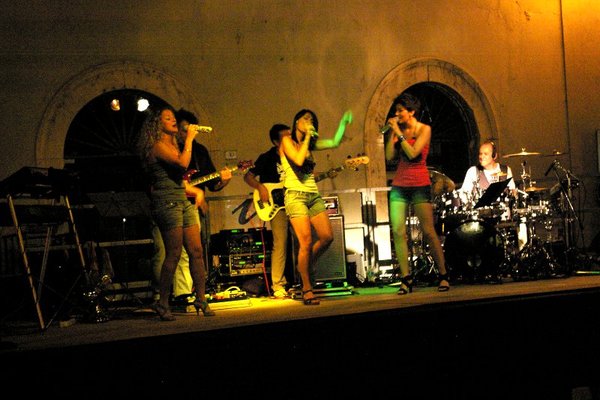
triple girl vocal pop group in the largest piazza, P. Mazzini. I play
covers and have a good time, but I don't think I'd like to be the
bassplayer in that kind of band. No matter your musical skills, you
might as well be a backing tape, because the girls in front get all the
attention.
I passed some time later to find that the singers had done a costume
change, and then later still, arrived during the couple of minutes when
they were off stage, changing again. (The musicians were playing a
prog-rock instrumental extension to the previous song.) The last part
of the set was composed of the kind of songs you might associate with
The Commitments or the Blues Brothers, and I enjoyed them enough to
stay. One girl had a definitely ballsier voice than the other two and
did a good version of R-e-s-p-e-c-t. They came on stage at ten and
finished at one, but I don't know if there were any breaks.
During one of my breaks from the pop, I'd spent some time listening to
some traditional "Mediterranean" music, as the leader described it.
With just guitar, violin, percussion and voices they produced a
surprisingly full sound, with that discordant, folky drone to it. A
pretty girl in black danced the tarantella and other steps I know not
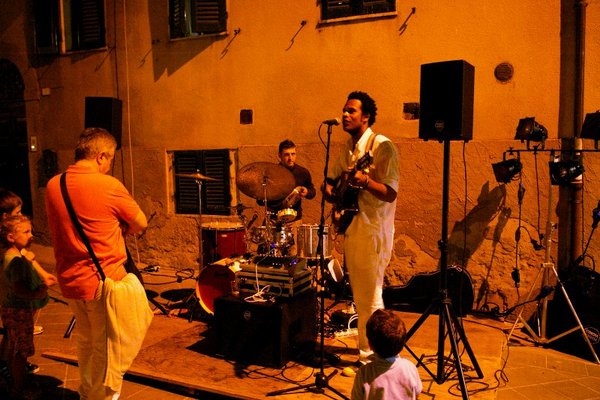
the names of. Round the corner from the main piazza, a black guy on
acoustic guitar backed by a drummer, both amplified, played Carribean
songs and had the passers-by dancing.
In a little alcove next to the church, I'd seen the gear for a band.
The banner behind announced them as "Shipmates" and bore a Rasta lion
and colours. Also, the bass cabinet was an Ampeg 8x10, suggesting some
serious dub was coming. And so it did. I really enjoyed the band, at
least for a while, but eventually found that the tunes were starting to
sound the same. But then it became apparent that the sambaistas were
back. Even though they were about fifty metres away, you could still
hear them over the bands quite loud amplification.
So I went and enjoyed the samba again. By the time they'd finished, it
was two o'clock and I decided that I was finished too. I walked back
down towards the car, but got diverted by a blazing bonfire. Disco on
the beach? Oh, all right then.
When I eventually arrived home, all was quiet. But I startled the big
orange cat which had been asleep on my porch.
Sunday 26th June
Needless to say, I felt the deficit of sleep, but this day was my last
chance to catch some of the Medieval festivities in Bevagna. It's
actually a recently instituted festival, but the idea is to recreate
the town as it would have been in the Middle Ages, with the emphasis on
the crafts which would have been practised. Four quarters of the town
compete to make over a section of townscape into a medieval theme park.
In Bevagna, that's made easier by almost all the buildings being seven
or eight hundred years old, at least. (One church incorporates Roman
colums in situ.)
It was about a seventy kilometre journey, but quite easy to navigate,
which was fortunate, the TomTom having finally expired. I'd made the
mistake of letting the dying battery go entirely flat, and after that,
no amount of charging would wake the device up. It was back to
navigating as we did in the old days, with signs and maps.
I got there about four in the afternoon and found that the handy car
park I knew of had been set aside for disabled drivers, and I had to
follow the signs to a field on the outskirts. And pay two euros. The
town was pretty packed with visitors, almost all Italian (the usual
kind of picture: a bit of Dutch or German heard occasionally; two
Japanese girls; and one Australian family).
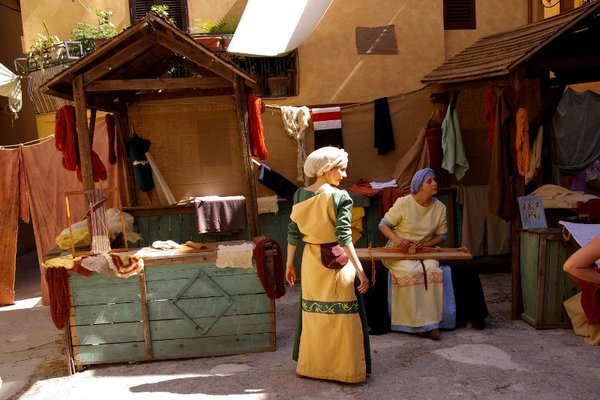
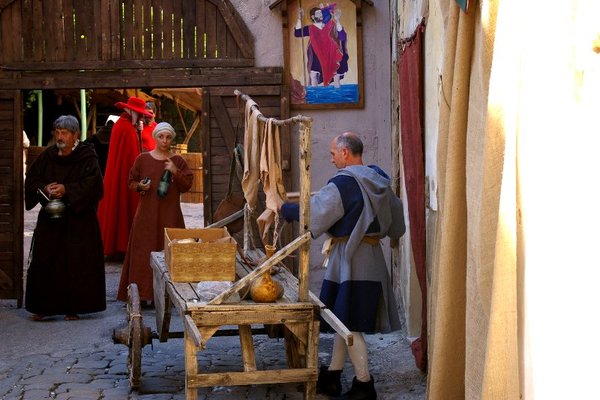
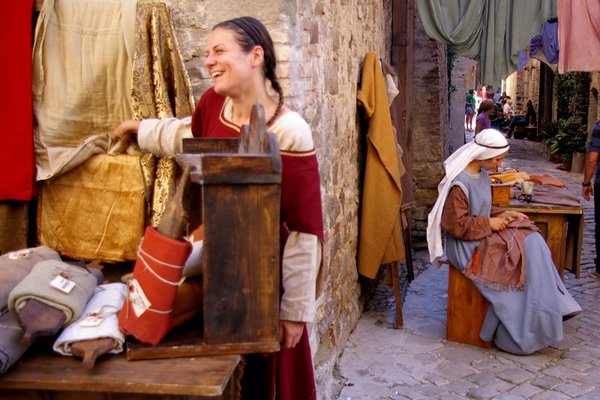
With the backdrop ready-prepared, the teams had converted their patches
with sackcloth and logs to create little shops and booths showing off
the medieval skills. Paper-making was big in the town. Weaving and
dyeing. Ceramics. Metalworking. To represent the farming industry,
there were animal pens, probably the only areas approaching a natural
medieval fragrance.
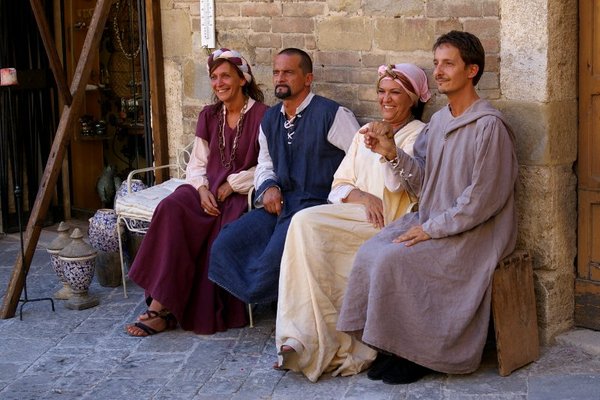
The Italians do seem to love dressing up, whether it's to be a rude
peasant in a burlap smock, or a fine lady in silks. I assume that they
keep these items in their wardrobes ready for use, because the quality
is better than something you would improvise for a one-off. The
medieval-style shoes, in particular, really look the part but wouldn't
be useful in other contexts. (Although generic and timeless sandals
were common too.)
I enjoyed all the teams offerings and took a good many photos, but by
around eight in the evening I'd had enough for the day. There were to
be more medieval goings-on in the main square, where four robust
dummies in the colours of the four quarters had been erected on the
stone steps. It looked as though they would be targets for something --
arrows or crossbow bolts, I guess. But I left them to it and returned
to the car.
Maybe I was tired, but three-quarters of the way home, on the motorway
at Magione, I remember thinking "that tower on the hill is just like
the one they have at Magione". Some minutes later, I was thinking "I
don't remember the lake being visible from the road like this". What
I'd done was drive straight past my exit. I pulled into an emergency
lay-by and looked at the map, and decided that the simplest thing to do
was carry on and go right round Lago Trasimeno. It was like going from
the three o'clock position to six o'clock by travelling anti-clockwise.
But once I got to Castiglione del Lago (nine o'clock position), I was
on familiar ground again, and was home in no time. I was quite tired,
but it wasn't a matter of dozing off because the older couple living
next door seemed to be having a grandchildren day. There were seven --
I think -- children running shreiking round the piazza.
Monday 27th June
Being low on food and petrol, I went back to Magione in the morning to
stock up. The fuel warning light in the car came on, even though its
computer said I had 150km remaining. With only two major trips planned
now, I didn't want to fill up the tank and leave the final filling for
handing back the car an unreasonably small amount. No real reason.
After putting €20's worth of unleaded in, the car claimed it could
drive for 400 kilometres. But I wasn't going anywhere else that day.
Definitely a day to stay at home and relax.
Tuesday 28th June
 I don't
care much for motorway driving, but I had to admit that it's
efficient for getting you where you want to go. And with no magic GPS
to guide me, there were advantages in sticking to the major roads. I
had decided to visit Gubbio, one of the more important towns in Umbria
which I hadn't yet seen. It would have been possible to plot a direct
route that was shorter than the motorway one, but quiite likely it
would have taken much longer.
I don't
care much for motorway driving, but I had to admit that it's
efficient for getting you where you want to go. And with no magic GPS
to guide me, there were advantages in sticking to the major roads. I
had decided to visit Gubbio, one of the more important towns in Umbria
which I hadn't yet seen. It would have been possible to plot a direct
route that was shorter than the motorway one, but quiite likely it
would have taken much longer.
In the event, all navigation went smoothly and I arrived at the planned
time, shortly after three. My guide book had mentioned free parking at
the Roman theatre, and primed by perusing a Gooogle map of the town the
night before, I easily found it and left the car (in the baking sun,
unfortunately).
There appeared to be a ticket charge for actually getting on site to
see the ruined theatre, but I decided I could see enough from outside
the fence. It's about the same size as the one I saw in Ostia Antica,
but not in as good condition.
Crossing the road back towards the town centre, I found the pedestrian
(tourist) route sensibly signposted. In fact, Gubbio does very well for
signs pointing tourists to the major sights. Nothing ugly or intrusive,
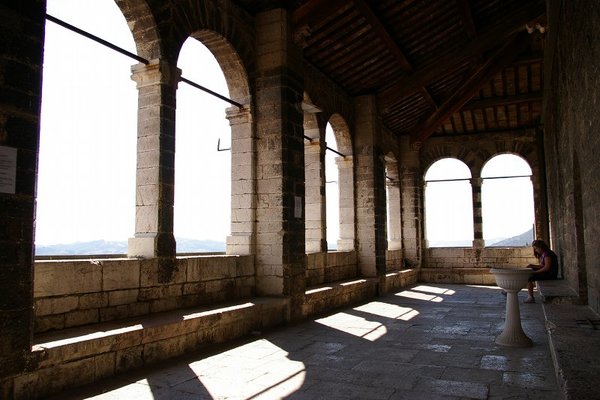
just useful. Although the town clings to the side of a steep mountain,
the climbs weren't as strenuous as I expected, and I was soon at the
Piazza Grande.
Or "Big Square"; lack of imagination in the nomenclature, but the
medieval engineers could not be accused of lacking vision. The town had
no flat space to place a town hall and a public square, so they built
one -- an impressive piece of work.
The building I called the "town hall" is actually the Palazzo dei
Consoli, the seat of the city's medieval government. Like most Italian
city republics, democracy gradually fizzled out and autocrats took
over, eventually the Pope. In the Palazzo now there's a museum,
including one of the most significant archaeological discoveries in
Italy, the Eugubine Tablets.
They are large bronze plaques, five in the ancient Umbrian language,
and two (presumably later) in early Latin. The Umbrian alphabet, like
that of the Etruscans, is closer to the original alphabet from
Palestine than is the Latin one which we still use today, and it goes
right to left. The state of preservation is totally surprising, with
all the letter shapes sharply formed (they were chiselled) and even the
spelling mistakes and corrections as clear as when they were done in
the BC centuries.
The tablets are much more accessible to view than I expected. No
armoured glass cabinets and discreet lighting and infra red beams. They
are in glass frames attached to wall pivots, a display mechanism
probably a hundred years old. There's a sign saying "don't touch", but
I had swiveled a couple of them round to look at the back before
noticing it.
There's one little video camera pointing at the tablets, the only one I
noticed in the whole museum. I began to think that it would be pretty
easy to steal the tablets, paintings, sculptures, altarpieces and
everything. The only difficulty would be getting a van big enough to
take it all away.
The tablets are the highlight of the museum, perhaps followed by the
original toilets (no longer in use). In the middle of a stone corridor,
there is a set of three, with a label explaining that the waste pipes
were built into the wall while it was being built (1332). Northern
European castles had toilets too, but they didn't have the ceramic pipe
technology.
 After the Palazzo, I went in search of one
specific church, San
Giovanni, used as a backdrop in the Italian television series 'Don
Matteo'. The eponymous Don Matteo is a crime-solving priest, played by
Terence Hill, founding star of the spaghetti western genre. He's the
one with the piercing blue eyes in 'My Name Is Trinity'.
After the Palazzo, I went in search of one
specific church, San
Giovanni, used as a backdrop in the Italian television series 'Don
Matteo'. The eponymous Don Matteo is a crime-solving priest, played by
Terence Hill, founding star of the spaghetti western genre. He's the
one with the piercing blue eyes in 'My Name Is Trinity'.
In the square facing the church I had a slightly odd encounter. There
was a public toilet in one building, with a payment turnstile at the
entrance, and a gentleman came out waving a one euro coin and asking
me, in Italian, if I had change. I thought I did, and picked out a
fifty cent, two twenties and a ten. As I was doing that, he asked me
"Lei é irlandese?" - are you Irish? He wasn't psychic: I was wearing my
little enamel flag badge. (I do that sometimes in Italy so that people
don't think I'm English or American.) So I answered "Si." as I swapped
the coins with him.
"Io anche," he replied - me too. "So, er, thanks very much then." he
said in English, and turned and disappeared into the loo. I was
probably partly to blame for the meeting being so inconclusive, since
I'm generally socially awkward, but as he went, I was at a loss to say
anything anyway. If we'd both had a few drinks in us, everything would
probably have been fine.
I set off to explore the town, and seemed to be drawn inexorably to the
chairlift without chairs. I'd read about it and had mentally tagged a
ride on it as "well, maybe" but bowing to the inevitable, I bought a
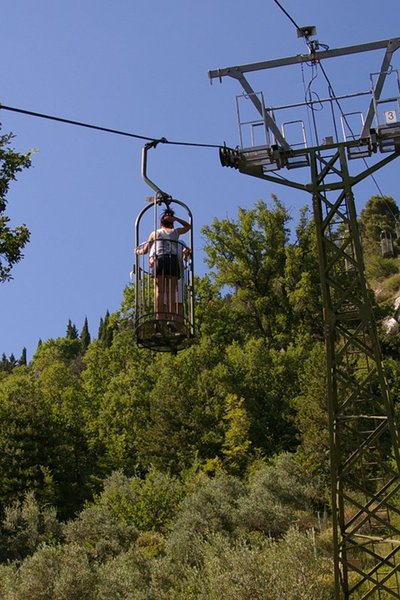
ticket. You travel up and down the mountain standing in a steel basket,
comfy for one, cosy for two. Actually, I was reminded of the cages used
in medieval times (or at least, in medieval movies) for displaying the
rotting corpses of executed criminals.
I'm a little nervous about heights, but the cable follows the steep
slope of the mountain, meaning that you are mostly only ten or twelve
metres above ground level. No major panic attacks, and great views all
the way up and down. I think the altitude difference is about three
hundred metres. At the top, there's a cafe and a hotel... well, that's
true, but the real reason for the lift's existence is the Basilica of
Saint Ubaldo, Gubbio's patron. Before the mechanical wonder was built
fifty years ago, the only way up was by a steep, twisty road.
Every building stone for the basilica must have been brought up by
donkey or creaking cart. It's an impressive achievement. Today, all the
stone has been scrubbed and restored, giving eveything a "too new"
look, but there's a pleasant cloister, and inside the church are kept
the three "ceri" or "candles", which are in fact heavy wooden and
papier maché columns about ten metres high. Every year, on
Sant'Ubaldo's day, three teams in costume race from the Cathedral
below, carrying the "candles" upright. There are always huge crowds.
I've seen the race on television, but never in real life.
When I came down again, I explored some more, checked out the Cathedral
(two 1000-year-old dead saints and two lower-rank bodies on display)
and some of the other notable buildings, and then set out for the lower
town on my way back to the Roman car park. I passed the Fonte dei
Pazzi, the Madman's Fountain, which has the associated legend that if
you circle it three times and wash with the water, you go mad. I tried
it: made no difference.
At the base of the town there is the Piazza Quaranta Martiri, named for
the 40 random citizens picked for execution by German troops in 1944.
Apparently, you can still see the bullet marks on the church wall. I
wasn't totally convinced, but I took a photograph.
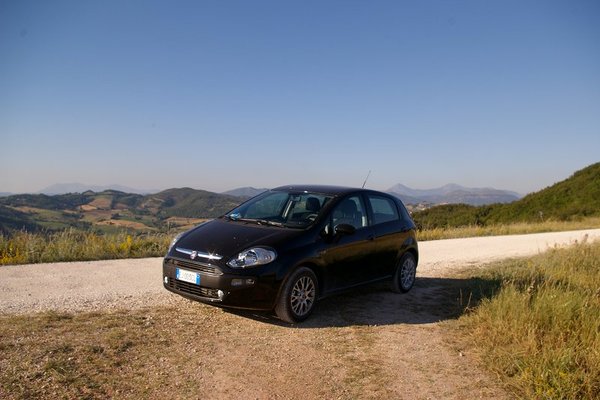 I returned
to the car and set off. I was hoping there would be a sign
for Umbertide, but I didn't see one, even though I was heading in
roughly the right direction. All the signs were directing me towards
Perugia and Rome, and I'd been there. Then I saw a sign for
Castiglione. I did think it was odd, since Castiglione del Lago is a
small town quite far away, but I took the turn. It was taking me
South-West, which was what I wanted, but it was only a few minutes
later that it occurred to me that there might be more than one
Castiglione.
I returned
to the car and set off. I was hoping there would be a sign
for Umbertide, but I didn't see one, even though I was heading in
roughly the right direction. All the signs were directing me towards
Perugia and Rome, and I'd been there. Then I saw a sign for
Castiglione. I did think it was odd, since Castiglione del Lago is a
small town quite far away, but I took the turn. It was taking me
South-West, which was what I wanted, but it was only a few minutes
later that it occurred to me that there might be more than one
Castiglione.
The road was not a major one, but it was well-surfaced, a condition
which gradually changed as I proceeded. Through twists and turns, and
getting higher and higher, the road was deteriorating. I was lost,
quite obviously, but I was not particularly worried, because I felt
sure, with the general direction I was heading, that I would hit one of
the main roads sooner or later. At the highest part of the route, the
road became a "white road" with just a gravel surface: interestingly
slippery. I thought it would make a good rally stage, but you wouldn't
want to skid off the road with no support crew following, as I didn't.
A big cloud of dust was all that was behind me.
I saw some roadsigns, and stopped and consulted my map. The sign said
that Montelovesco was 9 kilometres straight on, and from the map I
could see that the main road to Umbertide was another 5 after that.
Easy. What I'd actually done was to take a direct route across the
mountains (max altitude about 900m) instead of round the edge.
By the time I got to Umberide, it was well after seven, and given that
it would take me over an hour to get home, I only spent a short time
there. Call it an introduction. Umbertide has a lot of ugly new town
sprawled around the more picturesque old town, but the latter didn't
look bad when I took a stroll around.
I took the main road back to Perugia and onwards, taking particular
care this time to exit the autostrada at Magione and not miss it as I
had the previous time. Home in time for dinner (since I had to cook it
myself).
Wednesday 29th June
The plan was working well of taking a relaxing day at home doing
absulutely nothing after every big expedition. It was possibly slightly
cooler than the previous few days.
In early evening, I began to hear thunder, and while the view from the
back windows showed blue sky, from the front, facing the piazza, the
skies began to darken. The rumbles became almost continuous, and I
thought I saw the occasional flash. There was one brief splatter of big
drops of rain, but that was all. It was very humid, and the smell of
rain was strong.
I expected that at any moment, a real tropical thunderstorm would
start, with rain falling as though it was coming from a bucket, but it
didn't happen. A light shower started, and lasted for perhaps fifteen
or twenty minutes, but that was the end of it. I did feel fortunate
that I hadn't washed the car, badly needed after the previous day's
dusty driving on gravel roads. Adding rain would probably have made
more of a mess.
I did wash the car later that night. Can't drive around in a dirty car.
Brutta figura.
Thursday 30th June
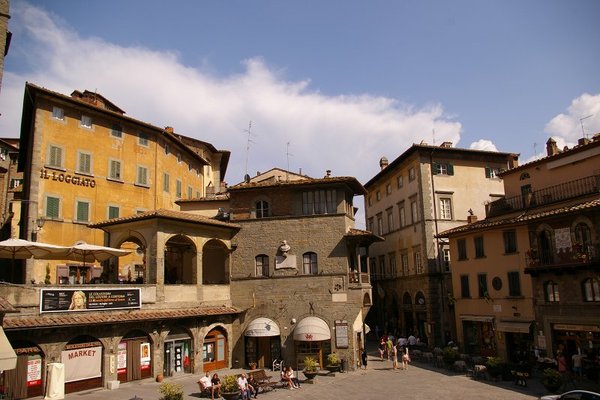 The plan
was for a venture into Tuscany, to visit Cortona. I'd been
there before, but it was seven or eight years prior. Cortona is the
location of the best-selling book "Under The Tuscan Sun", by Francis
Mayes. (I've always wondered if part of its success was that it sat on
the shelves next to the earlier travel best-seller, "A Year In
Provence". Mayes, Mayle, you see.
The plan
was for a venture into Tuscany, to visit Cortona. I'd been
there before, but it was seven or eight years prior. Cortona is the
location of the best-selling book "Under The Tuscan Sun", by Francis
Mayes. (I've always wondered if part of its success was that it sat on
the shelves next to the earlier travel best-seller, "A Year In
Provence". Mayes, Mayle, you see.
Actually the book had been bought for me one Christmas by my partner,
because she knew that the cold, dark, miserable Northern Winters
depressed me, and a dose of Tuscan sun was just what I needed, even if
vicariously. We had been to Tuscany together, but not Cortona.
The success of Mayes' book has put the town on the map for tourists,
particularly Americans, and I remembered from my first visit that I had
felt that the town was too full of tourists and that there was too much
English in the air. It wasn't enough to put me off the place, but it
certainly affected the ranking in my mental league table.
As I arrived at the bottom of the hill, the town above was illuminated
by the sun, but the sky was almost black behind it. The possibility of
rain was not something I had prepared for, after three weeks of solid
blue. I couldn't remember how I'd found parking on the previous visit,
but I followed the signs and found the big parking lot for tourists.
Their cars, I mean. It was less than a quarter full. There was a
convenient set of steps and escalators to get up to the base level of
the town at Piazzale Garibaldi.
It was obvious that the main tourist route from there was to the left,
along Via Nazionale, so being perverse, I turned right, up a much
steeper slope. This led me away from the popular core of the town,
around Piazzas Signorelli and Reppublica, into much less explored
territory. I didn't see a single tourist. I did see some five or six
teams of builders working on refurbishing ancient houses. I imagine
there's a good market for restored houses in Cortona. The book again.
I was getting a whole new perspective on the place though, wandering
lost through the ancient alleys and uneven levels. The threatened rain
arrived, moderately heavy, and I took shelter in the involuntary
generosity of a resident's front porch. It only rained for twenty
minutes or so. By that time, I had decided that I'd better go and see
the more famous parts of town, although it did take me two attempts and
one circular detour to find them.
The town centre had a fair filling of tourists and locals, but it
wasn't especially packed. I sat on the town hall steps for a while and
absorbed some atmosphere. There was a banner advertising a special
museum exhibition, the Louvre's collection of Etruscan material, looted
from -- sorry -- collected in the nineteenth century, from around
Cortona and the surroundings, the core of the Etruscan "nation". I'm
not much of a museum fan, but since this was a rare opportunity, I paid
the whopping ten euros entrance fee and went in. It was a very good
display, with everything exhaustively labelled in Italian, French and
English. I was really struck by how advanced the Etruscan civilization
had been, 700BC or before.
My ticket also gave me entry to the main museum, but I tired of that
about half way through, although I then found out that it was difficult
to leave without following the recommended route to its conclusion.
Eventually I saw the egress.
It was about six-thirty by then, and feeling hungry, I walked back
towards the car. I wouldn't be having dinner quite then though, because
I still had a target to tick off. Passignano sul Trasimeno is on the
opposite side of the lake to "home", and I had yet to visit. I parked
the car and took a stroll along the prom and back, as the sun was
getting lower over the lake. I only spent about an hour there, but it
was enough to get a flavour of the place.
Friday 1st July
My last day was, intentionally, another lazy one, but the weather
provided some entertainment. Another thunderstorm, with more serious
rain than I'd seen on the previous couple of days, although still not
as dramatic as I'd seen before in Italy. In Lucca, the year before,
rain fell as though it was pouring from a massive bucket.
But the sky became massively dark, contrasting with the pale stone of
the old houses, and the lightning flashed and the thunder rumbled. I
found that my 3G Internet dongle was still working. I hadn't known if
it worked by calendar month, and would expire at the start of July, or
carry on with whatever credit remained. But I cautiously refrained from
poking it out of the window as usual. What if it got struck by
lightning?
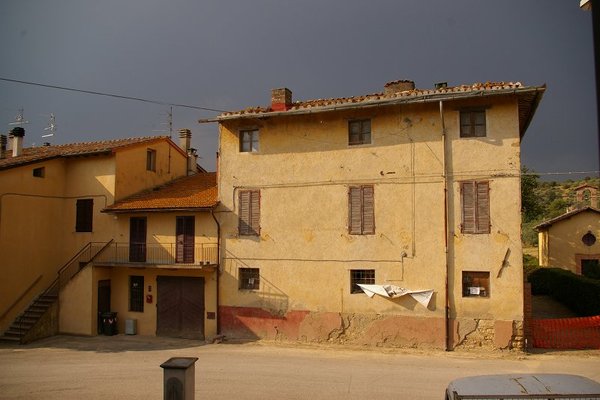 By late afternoon, the weather had cleared up. I walked
down to the
lake shore for a final look at the sunlight dancing on the water, and
went out to the end of the pier. There weren't many people around. On
most days, there would be campers soaking up the sun on the lawns round
the campsite, facing the lake, but probably the earlier rain had
deterred them. (Or they were busy drying their tents and camper vans.)
It actually was very warm and sunny again.
By late afternoon, the weather had cleared up. I walked
down to the
lake shore for a final look at the sunlight dancing on the water, and
went out to the end of the pier. There weren't many people around. On
most days, there would be campers soaking up the sun on the lawns round
the campsite, facing the lake, but probably the earlier rain had
deterred them. (Or they were busy drying their tents and camper vans.)
It actually was very warm and sunny again.
As I walked back up the parallel road from the shore, I saw the
"village hall" had some activity, with cars in the car park. It was the
first day of the Sant'Arcangelo "Festa" or "Sagra". All towns and
villages like to have one in the Summer months, and they are almost
always based on a type of food. I've seen a festa of truffles, which is
the sort of thing you might expect, but pretty much anything goes.
Artichokes, mushrooms, quiche, watermelons, fava beans, lentils. I
suspect that it's de rigeur to choose something that no neighbouring
village is celebrating. I even saw posters for a festa of würstel --
German sausages. Obviously, Italy does have a German-speaking region,
which contributes to the cuisine (dumplings, speck, sauerkraut,
strudel) but it isn't in Umbria.
Sant'Arcangelo's subject is the local fish fillet, which is fair enough
for a lakeside community, even though little fishing goes on now. I'd
picked up a booklet of the programme from the local shop, and there was
something on every night for ten days, with different food being
available, and "The Drunken Fish" pub open. In fact, it was only that
day when I worked out where the building was. In the photos in the
brochure, (from previous events), it had a distinctive pink plaster,
but I didn't recall seeing it in the village. It was only the activity
around the place that drew my attention.
If the festa had started a day or so earlier, I'd probably have dropped
in to the Drunken Fish, or watched some of the bands, but I had to make
my own dinner to use up food left-overs, and I thought a hangover
probably wouldn't be the best accompaniment to travel the next
day. And to be honest, I was depressed to be leaving, and not in the
mood for socialising.
Saturday 2nd July
I couldn't remember if Marco and I had decided on ten or eleven in the
morning to hand over the apartment keys. He arrived at ten-thirty on
the dot, so we must have agreed ten (Italian punctuality). That was a
perfect time for me to drive to Chiusi and hand over the rental car
exactly on time, although I doubt if they'd have been strict. On the
way, I filled up the tank with petrol, paying with a fifty-euro note.
That left me with a twenty and some change, which was good. No point
bringing home unspendable currency.
The timing also allowed me to catch the first of two trains I'd
identified. Either one gave me some time in Rome, but as well as
leaving an hour earlier, this one was a faster InterCity, giving me
still more free time. The ticket machine said that there were no free
seats in second class (it was coming from Milan to go on to Naples
after Rome), just standing space. I paid the extra five euros for first
class. I got an assigned seat, but it was pretty crummy for first class.
At Roma Termini (it's named after the Roman thermal baths, it's not a
terminus) I left my case in the left luggage and went out to spend my
couple of hours at liberty. The station is so huge that I had no idea
of where the nearest exit would take me, but I went out anyway. This
proved to be a mistake, because I was in a very dull urban area, and
literally "the wrong side of the tracks". When I got my street map out
and tried to navigate to tourist Rome, I had to make a long detour to
find a way across the railway.
I walked through what seemed to be Rome's unofficial Chinatown in the
Esquiline, around Piazza Vittorio, then through the park where the
remains of Nero's "Golden House" are being established as a new tourist
site, and after a sit-down in the shade, on to the Colosseum, built to
erase Nero's work. I reckoned I had time to walk up to Piazza Navona,
and then back to the station. On the way, I accidentally encountered
the Theatre of Marcellus, a historic ruin I hadn't yet seen, and next
to it the Portico d'Ottavia, of elegant Roman columns, but grotesquely
patched up with bricks in the Middle Ages.
It was quite familiar territory after that: the Tiber at its island,
the ruins at Torre Argentina, Piazza Navona with its "artists" selling
to the tourists, Trevi Fountain, Piazza di Repubblica, and Termini
station. I collected my bag and took the train to the airport. I was on
schedule. Airports are boring - nothing to report after that, except
that in the queue for check-in to my flight there was a large group of
teenage schoolgirls (underdressed) and also a party of Irish priests.
It did make me think of Father Ted. With hilarious consequences, etc.
etc. But in fact there were none.
I got a lift from Belfast airport to collect my car and drove home. It
was about half-past midnight when I arrived.