Saturday
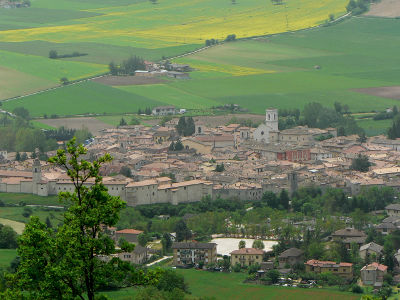 Taking it easy at first, the
morning was spent in a trip to Preci (by car) and then on to Norcia. The
weather forecast had been for rain, but although it was overcast all morning,
no rain appeared. After coming home for lunch and a siesta (well, not actually
a sleep; I haven't mastered that yet) in mid-afternoon, we went to Spoleto.
Taking it easy at first, the
morning was spent in a trip to Preci (by car) and then on to Norcia. The
weather forecast had been for rain, but although it was overcast all morning,
no rain appeared. After coming home for lunch and a siesta (well, not actually
a sleep; I haven't mastered that yet) in mid-afternoon, we went to Spoleto.
Spoleto is still as hilly as ever, of course, and everything is always up hill. It was hot and humid, although the
clouds were dispersing and blue sky appearing. We went (uphill) to the Ponte
delle Torri, the fantastic medieval bridge across the valley, and out along its
walkway. Being nervous of heights, it scares the bejesus out of me, but my
visitor has no fear of high places at all. Unnatural. There's a little lunette
above the central span where you can look out, or down if you must. According
to my guide book, the actual building of the bridge is undocumented, but is
thought to be about Thirteenth Century, probably on top of the remains of a
Roman acqueduct or viaduct.
Back from the bridge, we walked (uphill) to the castle, the Rocca Albornoz,
named after the cardinal who commissioned it to suppress the independence of
the city in 1359. I hadn't been in the castle before, but found it interesting.
Between the unification of Italy (and the loss of Spoleto from Papal
possession) and 1982, the castle was a high-security prision, but on
decommissioning, it was restored and many of the original frescos were
revealed. What is striking about these, very different to the ones you see in
churches, is the military and chivalrous subject matter. There are large and
extravagantly-designed coats of arms, and also scenes of knightly pursuits,
like battles, jousting, hunting, and courting the ladies.

The castle is the highest point in Spoleto, so everything is downhill from
there. Except, of course, you often have to go up to go down. We took a tour of
the cathedral and other interesting sites. I particularly like the church of
Sant' Asano and its earlier crypt, dedicated to Sant' Isacco. In the crypt, you
can see traces of building, suggesting continuity from Roman times, and
probably pagan times.
Then it was home for dinner and too much red wine.
Sunday
My visitor particularly wanted to go to Assisi, and off we went, making it
my fourth visit this year, and fifth over all. The weather was hot and bright.
We made the obligatory visits to Santa Chiara and San Francesco (both doing
well) and took in the ambience. And then a pizza.
There are always a lot of tourists in Assisi, but this time of year it's not
too crowded. In fact the biggest crowding hazard is often school trips rather
than coach parties. I like the feel of the place, and could happily spend more
time there, although probably not permanently. Despite the appeal of the cosy
medieval town (and possibly the option of actually seeing stuff in Calendimaggio), I doubt it
would be practical. And the modern town below, Santa Maria degli Angeli, is
just too modern.
After having had enough of Assisi for the day, we went on to Bevagna and
Montefalco, a short detour in the general direction of home. Although it meant
passing right by the walls of Bevagna, I wanted to have a look at Montefalco
first, not having been there for several years. Although small, the town has a
lot of history, particularly in the wars between Popes and Emperors. It was
conquered and rebuilt by Frederick II in 1249 and named for the falcon on his
Imperial insignia.
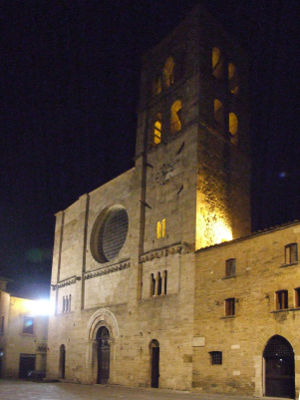 Back then to Bevagna (a slight giro of the town ensued after missing the
entrance to the car park I was looking for). There was a market on: the sort of
thing where people try to sell old stuff which they call "antiques" and which
in fact is "junk". And handicrafts and craft jewellery and so on. I do like to
have a walk around that sort of event out of curiosity and to enjoy the
atmosphere.
Back then to Bevagna (a slight giro of the town ensued after missing the
entrance to the car park I was looking for). There was a market on: the sort of
thing where people try to sell old stuff which they call "antiques" and which
in fact is "junk". And handicrafts and craft jewellery and so on. I do like to
have a walk around that sort of event out of curiosity and to enjoy the
atmosphere.
The rest of the town was quite busy, as you might expect for an early Sunday
evening: people strolling, meeting, chatting, walking the dog, pushing the
pram. Time to have a gelato and sit on the steps in the piazza, watching the
world go by. Then, later, although probably very early by Italian standards, we
went for dinner at a nice little "homespun" restaurant in Piazza Garibaldi. No
menus, just a board, which the young waitress brough to our table and explained
in excellent English. (The dishes weren't the usual tourist fare, which was why
an explanation was helpful.) The restaurant had a resident cat, a tabby with
big, serious eyes. You're always safe with people who like cats.
(I know there's also a kind of urban legend
joke that says you should never eat at a Chinese restaurant if all the cats in
the neighbourhood have disappeared, but that's just xenophobic. And only very
slightly funny.)
We both enjoyed our meals a lot, and contentedly strolled back to the car
through the yellow-lighted medieval streets.
Monday
My visitor had to get the evening flight back from Rome. After a pleasant
"at home" morning, we drove South in the early afternoon. Outside Terni, we
visited the Parco Fluviale, the river park, to see the falls at Marmore. The
Cascata delle Marmore are the highest falls in Italy, but are unusual in being
artificial. In 271 BC, Roman engineers cut a channel to drain the marshes at
Rieti, and let the waters drop a spectacular 165 metres into the river Nera.
In modern times, the flow of water was diverted to generate electric power,
making the falls unusual in another way: most of the time, they're switched
off. If you go outside certain regular hours, all you see is the overflow --
still a high waterfall, but not too impressive. But on the schedule, a siren
sounds and the water is diverted back to the falls, resulting in an immense
increase in the flow and sound and spray of the falls.
 Fortunately,
I had a leaflet with the schedule for May, and knew that the full flow would
run between four and five o'clock. We went to the lowest and most accessible of
the viewing points for four. It's the Balconi
degli Innamorati, the Lovers' Balcony. I had to look up "innamorati",
having forgotten its translation, just to make sure that it didn't mean
"inundated" or "drowned" or something. In fact, the little balcony is
approached through a dripping tunnel through the cliff, so you do get a little
wet getting there.
Fortunately,
I had a leaflet with the schedule for May, and knew that the full flow would
run between four and five o'clock. We went to the lowest and most accessible of
the viewing points for four. It's the Balconi
degli Innamorati, the Lovers' Balcony. I had to look up "innamorati",
having forgotten its translation, just to make sure that it didn't mean
"inundated" or "drowned" or something. In fact, the little balcony is
approached through a dripping tunnel through the cliff, so you do get a little
wet getting there.
But then when the siren sounds and the waterfall slowly builds up to its
maximum, that's when you really get wet,
as the spray fills the air like a medium-scale downpour. Most people, me
included, stuck it for a moment and then ran back to the tunnel. Although,
since it was a very hot day, a wetting wasn't entirely unpleasant.
The higher viewpoints are reached by steep, winding paths up the cliffside,
and in the heat, the climb nearly finished us off, bearing in mind that we had
to do it in under an hour (40 minutes, medium-hard, the leaflet says). But it
was rewarding in the end, with a great vista of the entire falls, and the
rainbow spanning the valley. But then, with the clock still ticking, although
after restoring hydration with water (me) or Coke (her), we rushed back down
again to catch the view from ground level at observation point Byron.
Apparently he wrote a poem about the falls.
After five o'clock, the flow declined to the original trickle until next
time. Next morning between nine and ten, I think, although in the high tourist
season the water flows for longer and for more sessions, including an evening
one; with artistic lighting effects, I'm sure.
The falls are right on the edge of Terni city, unfortunately an industrial
and not very scenic part as well, which was what we witnessed, slowly, with
roadworks, as we made the return to the motorway to Rome. And found it too, in
spite of the roadsign erectors suffering random indecision on whether to call
it the Firenze-Roma or Milano-Napoli. In fact, there seems to be a dearth of
signs mentioning Rome in Terni. Maybe they're pretending it's not there.
We got to the airport in good time, had a meal, and I saw my visitor checked
in and dispatched through the security gates. I made speedy progress getting
home, although I was quite tired. When I got back, it was clear that the area
had suffered a heavy rainstorm some time during the day, and our picnic chairs
outside the door had blown away. For us, it had been blistering blue skies all
day long.
Tuesday
No chance of any travels after the exertions of the previous day. I read a
little, sat in the shade, put some washing through the machine, and listened to
some music. The sky remained faultlessly blue, and the temperatures constantly
high. In the evening, there was a news item on television about the record
heat. "Record Temperatures All Week" it said, but I wasn't clear whether that
meant the past or future week. Anyway, 31 degrees, which is hot for May.
In fact, this day marked the ten-days-left point of my stay in Italy.
Slightly depressing.
The news also mentioned the "scandale" in the UK about MPs' expenses,
calling the Speaker, Michael Martin, the "president of the chamber of
deputies", which I think expresses the position quite accurately as far as
Italians are concerned. Likewise, in the English-speaking press, Berlusconi is
called "Prime Minister", when in fact, he is "President of the Cabinet" in
Italy.
In the early evening, four guys appeared, and went towards one of the other
apartments. Neighbours I didn't know I had, given that I was home by eleven and
almost immediately in bed. I suppose they'd come back after that, and then left
before nine when I got up. Active sorts, presumably, particularly given the
record heat. I heard them speak to each other, but not clearly enough to spot
the language. I waved in a friendly manner anyway.
Now that the series of Squadra
Antimafia is over (the Capo's boyfriend was a bad'un. I knew it all
along: he was a ginger, with a beard) the evening choice on television is
between Colorado and another police
thriller, the German Special Squad Cobra
11, dubbed into Italian. Back home, that was my occasional Italian
practice, since it has subtitles for the deaf. Here, I have a set too stupid to
do teletext subtitles, so I have to try to follow the spoken Italian.
As far as Colorado is concerned, most of the time I have no idea what is
going on, but the bizarre nature of it has a strange hold on me. And, probably
like most of the male Italian audience, I'm captivated by the female presenter
in the five-inch heels dispensing with dignity and joining in the sketches.
Wednesday
I woke before six and couldn't get back to sleep. When I looked out of the
living room window, I could see that the very top of the mountain opposite,
above Preci, was lighted with the first rays of the sun, and so before getting
back into bed, I opened the shutter of the bedroom window to wait for
sunrise.
It took a while. The geography and time of year meant that the sun didn't
reach my window until around half-past seven, and Preci had been in full sun
for almost an hour. On the other hand, sunset will be later here than across
the valley. Which is much more useful if you don't generally get up at six.
I eventually dozed off again, being woken by voices around nine. I think it
was the neighbours. Certainly there was no sign of them a little later when I
got up. The usual breakfast of a croissant and a gigantic espresso. I do like
my espresso in the mornings, even though cleaning the device afterwards each
time is a bit of a chore. It's one of the two-part, octagonal pots. I'm sure
you know the type.
Work started on replacing the stone edging around the swimming pool to
prepare it for the Summer season. Before noon, a gardener had appeared and
began to mow the grass paths around the farmhouse, all in the heat of the day.
What happened to siesta? I think he took his lunch break after one and came
back after two to begin with the petrol brush-cutter. The noise was too much. I
had only planned to go to Norcia for groceries and diesel, leaving it until
after Co-op opening time, but I got in the car and drove to Norcia too early
for Co-op.
I had realised the day before that in my short remaining time, I should
really go and see Castelluccio and the Altiplano. After a refuelling stop, I
checked the map and decided that I'd do it right now. Castelluccio is just 28
kilometres from Norcia, although a fair proportion of that is upwards. As I
drove past the 1200m, 1300m, 1400m markers, the temperature dropped. The car's
gauge was showing 26 degrees in Norcia, but only 16 by the time I got to
Castelluccio.
If I'd been naming these diary entries instead of just giving the day of the
week, this one would have been "High Plains Drifter". The final approach to
Castelluccio is across the Pian Grande, a large plain, flat as a lake, at about
1300 metres altitude. After winding all the way up, and then down a bit, the
road runs straight as an arrow across the plain. The highest mountains of the
Sibillini range surround it, still, in May, heavy with snow. In the middle of
the plain is an attempt a Western-style ranch, which would almost pass. It was
deserted, although the tumbleweed had to be imaginary, but there was horse shit
on the road, suggesting that the posse had left a little earlier.
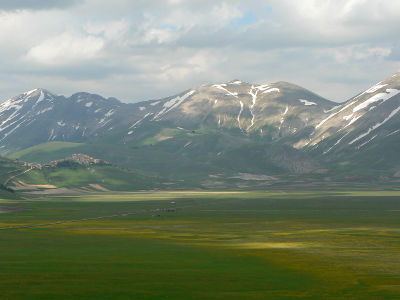


Actually, the whole plain is absurdly cinematic. If it hasn't yet been used
by a director with an extra-wide-angle lens, it's only a matter of time. The
town of Castelluccio itself is a bit wild-west, crossed with normal Italian
hill town. There were scruffy bars clearly aimed at climbers, tourists and
similar nutcases, and when I parked the car, a troupe of unaccompanied donkeys
came down the main street.
The National Park recommended route doesn't even include the town, veering
off toward Arquata a couple of kilometres short, but when I came back to that
junction, I returned by my original path, needing to get to the Co-op for my
groceries. As I approached the store, I passed (carefully) an older gentleman
tending Co-op-wards on a Segway, silver and red, the red to match his shirt. A
minute later, I found that he had driven the thing right inside, and was
scooting round the aisles.
Back home, work was still going on, even though it was almost seven, but all
the noise had stopped a short time later. Apart from the racket made by the
crickets. I strolled down to the pool area to see what had been done. All the
old edging had been removed already, and the new stone laid out ready for
placement.
Thursday
I slept right though to ten o'clock. Not much consistency in my body clock.
Possibly needs a new battery. It was another scorcher of a day. On the news,
the heat wave had gone from "happy people enjoying the weather" to "emergency
services on the alert". I went across the courtyard and looked at the
thermometer on the wall. Twenty-two degrees already.
Down at the swimming pool, a young workman in just shorts and gloves was
using a grinder to take off the old cement adhesive. It's far enough from the
house so that the noise wasn't too intrusive, particularly when I turned the
music up. (I bought a €20 set of computer speakers to run the MP3 player
through. Quite adequately loud.)
The only way to bring the heavy edging stones to the pool was by driving a
car across the courtyard, right past my front door, a novel experience.
Actually, that was about the height of my excitement for Thursday, apart from
when two swallows flew at high speed past my head. I was in the living room at
the time, typing on the computer at the table.
In this spell of hot weather, when I've been at home I've opened the front
door and the window, which are almost opposite, to ensure a flow of cooling
air. And of small, fast, loud birds, on this particular day.
When I sneaked a look at progress after working hours, the edging seemed to
be about three-quarters done, although grouting was still to be done. I
reckoned on another day's work to finish everything, meaning that the swimming
pool could be in operation before I leave. I'm not a great fan of getting wet
all over, but in the heatwave, I might be tempted.

Friday
Signor Brush-Cutter came back. I drove over to the village to post a letter
and could still hear the sound of his machine from across the valley. The
poolbuilders were hard at work too, but at least they weren't using noisy
machines. I did consider just going for a drive to avoid the racket, but
decided that it wouldn't be a very ecological use of fuel. Anyway, how much
more undergrowth could he possibly need to clear? I noticed that in the areas
he'd cut, he had cut round the poppies,
leaving them standing. Can't be all bad.
In the last week, some of the fields which had a generous sprinkling of red
poppies have also acquired a more solid sheen of pink. Some sort of vetch, I
think, although I know little of flowers. In general, the quantity of wild
flowers is much more than I'm used to. There is colour everywhere.
I was right about the cutting. It ended quite early and all was quiet, apart
from the crickets and the distant chatter of swimming pool construction. I was
able to have lunch outside in peace, and was finishing my glass of wine when
Sergio appeared with two gentlemen, one of whom talked a lot, rapidly, in
Italian, and one who was silent. The talker turned out to be English, however,
and spoke to me of things he knew of in Ireland: stately homes and their
occupants, as it happened. Un poco
furbo, though, I thought. I wasn't quite sure what the objective of the
visit was, with Sergio showing them round some of the apartments, but I thought
it was something to do with marketing to the British.
In mid-afternoon, it became a little overcast, and the temperature dropped
to about twenty-five, which I think is my ideal comfort level. I went out with
the camera and photographed poppies and other flowers.
As I was chopping vegetables for dinner, Sergio appeared again and presented
me with two large bottles of mineral water. The pool was being filled from the
farm's well, and there was a chance that the exceptional flow might disturb
sediment, or otherwise interfere with the suitability of the water for
drinking. Incidentally, I'd been happily drinking the tap water since arriving,
trusting to its high mountain purity. Anyway, he assured me that things would
return to normal in a day or two.
After dinner, I went down to the pool to see what had been done, and, as I
expected, the new edging was complete and smooth, and the pool interior had
been cleaned. There were four built-in inlets for water, each pouring about as
much as a garden hose. The deep end wasn't even ankle deep. It could take a
while.